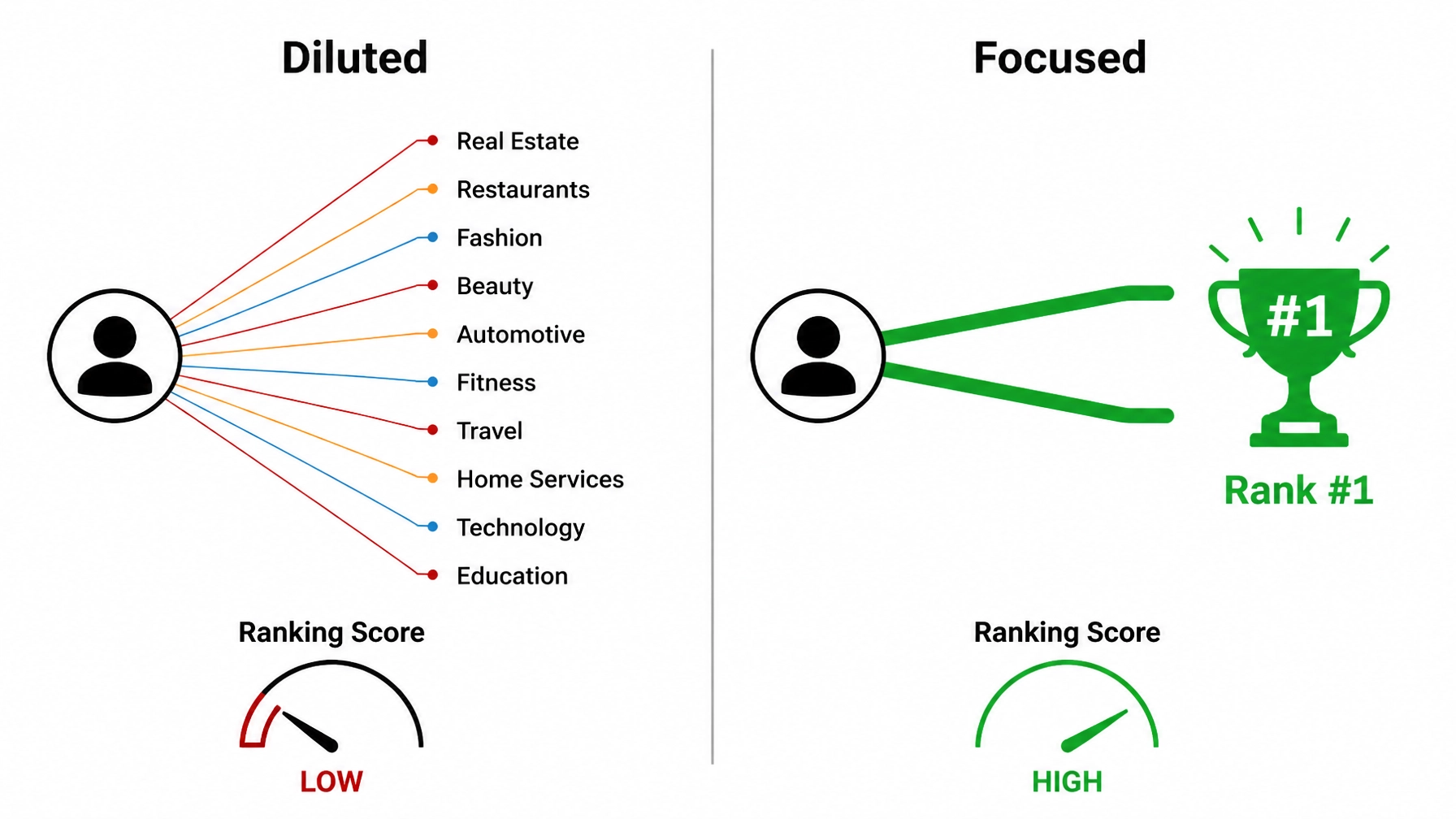
Your Google Maps ranking is a lie.
You see your business at the top when you’re standing in your office. You think you’re winning. You aren’t.
Step two blocks away and you vanish. You are invisible to the customers who matter. You are losing calls to competitors who don’t even provide a better service. They just understand the machine better than you do.
The "experts" tell you to fill out every field. They tell you to pick as many categories as possible. They are leading you into a trap. This is Category Dilution, and it is a direct deposit into your competitor’s bank account.
The Category Dilution Trap: Why More is Less
Most local business owners think that adding ten categories to their Google Business Profile (GBP) increases their reach.
It doesn't. It throttles your authority.
Think of your ranking power as a finite resource. If you have 100 units of "ranking juice," and you select one primary category, you are a heavy-hitter in that niche. You have Signal-to-Noise Ratio dominance.
When you add five secondary categories that are only tangentially related, you are fragmenting your signal. You are telling Google you are 20% a plumber, 20% a contractor, 20% an HVAC tech, and 20% a handyman.
Google’s algorithm doesn't like ambiguity. It likes certainty. When a high-intent customer searches for "Emergency Plumber," Google doesn't want a "jack-of-all-trades." It wants the specialist.
By trying to be everything, you become nothing. You become a "local footnote."
Forensic Category Pruning
To fix this, you need a Category Pruning operation. You must identify your "Money Category." This is the one that drives 80% of your actual revenue.
- The Primary Category: This is "what you ARE." It must be laser-focused.
- Secondary Categories: Use these sparingly. They should only be used if they represent a massive, distinct revenue stream.
- Services vs. Categories: Use the Services section for your "breadth." Services are "what you DO." They don’t dilute your primary signal, but they provide the context Google needs to trigger your profile for long-tail searches.

The Metadata Scalpel: Precision Entity Congruence
Your GBP does not exist in a vacuum. Google is constantly cross-referencing your profile with your website.
If your GBP says you are a "Property Management Company" but your website's metadata focuses on "Real Estate Investing," you have created Incongruence.
This is a red flag for the algorithm. It creates a "relevance ceiling" that no amount of reviews can break through. You need Entity Congruence.
The Surgical Alignment Process
Your website’s headers (H1, H2), your meta descriptions, and your schema markup must act as a unified chorus.
- Metadata Surgery: Your Title Tags should mirror your Primary GBP Category.
- LCP Targets: If your website takes 4 seconds to load, Google will throttle your Map visibility. Speed is a ranking signal for the Map Pack.
- Technical Surgeon approach: We don't just "fix SEO." We perform a forensic audit of your site's architecture to ensure your local search visibility isn't being choked by technical debt.

Geo-grid Tracking: The Only Metric That Matters
Stop looking at "Average Rank." It is a vanity metric designed to keep you paying for mediocre results.
If your "average rank" is 3, but you rank #1 at your front door and #20 three blocks away, your average is meaningless. You are still missing 90% of the market.
We use Geo-grid Tracking. This is precision mapping that shows your ranking at every major intersection in your city. It exposes exactly where you are bleeding revenue.
Results You Can Actually Hear
We don't care about "impressions." We care about the phone ringing.
When we identify a "cold spot" on your Geo-grid, we don't just wait. We apply Map Visibility Optimization. We align your on-page metadata and your category structure to "push" your ranking into those intersections.
Look at the data below. This is what happens when you stop guessing and start using a surgical approach to Google Maps marketing.

Reputation Management: More Than Just Stars
Everyone knows they need reviews. Most people do it wrong.
They get 50 reviews in one week and then nothing for three months. This looks like manipulation to Google. It triggers the spam filters.
You need a Review Cadence.
Google looks for a steady, natural heartbeat of feedback. More importantly, it looks for Keywords in Reviews. When a customer mentions your primary category or a specific service in their review, it strengthens your Entity Congruence.
We structure review cadences to reinforce trust and authority. We don't just ask for stars; we engineer the feedback to feed the algorithm what it wants to see.

The Choice: Dominance or Death
The local search landscape is a zero-sum game. There are only three spots in the Map Pack.
If you aren't in those top three spots, you are effectively out of business for the 80% of customers who never click "More Places."
You are currently either:
- The Dominant Authority: Owning the intersections, capturing the calls, and scaling your revenue.
- The Local Footnote: Paying for a website no one sees and a GBP that only ranks when you're standing on your own roof.
There is no middle ground.
Most agencies will tell you it "takes time." They will sign you to a 12-month contract and send you colorful reports that mean nothing.
We don't do that. We have Zero Long-Term Contracts. We stay accountable by delivering consistent momentum. If you don't hear the phone ringing, we don't deserve your business.
Stop Bleeding Revenue Today
Your current situation is likely a critical failure of category alignment and technical execution. Every day you wait is another day your competitor takes a booking that should have been yours.
You need a Forensic Map Audit.
We will perform a deep dive to identify exactly where you are being throttled and which competitors are stealing your visibility. This isn't a "free report" generated by a bot. It is a manual, surgical analysis of your local entity.
Leave a Reply