<!-- FINAL: Desktop balanced + Mobile: logo + CTA top row, menu below -->
<style>
  :root {
    --bg_nav: rgba(255, 255, 255, 0.85); /* Glassmorphism background */
    --fg: #0f172a;
    --link: #334155;
    --linkHover: #18a36f; /* Green on hover */
    --btn: #18a36f; /* RankLift Brand Green */
    --btnHover: #158b5e;
    --btnText: #ffffff;
    --line_nav: rgba(226, 232, 240, 0.6);
  }

  .nav {
    position: sticky;
    top: 0;
    z-index: 10000;
    width: 100vw;
    margin-left: calc(50% - 50vw);
    margin-right: calc(50% - 50vw);
    background: var(--bg_nav);
    backdrop-filter: blur(12px); 
    -webkit-backdrop-filter: blur(12px);
    border-bottom: 1px solid var(--line_nav);
    box-shadow: 0 4px 20px rgba(0, 0, 0, 0.03);
    font-family: 'Inter', system-ui, -apple-system, sans-serif;
    transition: all 0.4s cubic-bezier(0.4, 0, 0.2, 1);
  }

  /* Scrolled state for even more razzle dazzle */
  .nav.scrolled {
    padding: 2px 0;
    background: rgba(255, 255, 255, 0.95);
    box-shadow: 0 10px 30px rgba(0,0,0,0.08);
  }

  .nav-inner {
    max-width: 1200px;
    margin: 0 auto;
    padding: 0.8rem 1.5rem;
    display: grid;
    grid-template-columns: auto 1fr auto;
    grid-template-areas: "brand menu cta";
    align-items: center;
    gap: 1.5rem;
  }

  .brand { 
    grid-area: brand; 
    display: flex; 
    align-items: center; 
    text-decoration: none; 
    transition: transform 0.3s cubic-bezier(0.175, 0.885, 0.32, 1.275);
  }
  
  .brand:hover { transform: scale(1.03) rotate(-1deg); }
  
  .brand img { 
    width: clamp(130px, 15vw, 190px); 
    height: auto; 
    object-fit: contain; 
    display: block; 
  }

  .menu {
    grid-area: menu;
    justify-self: center;
    display: flex;
    gap: 2.5rem;
    align-items: center;
  }

  .menu a { 
    color: var(--link); 
    text-decoration: none; 
    font-weight: 500; 
    font-size: 15px;
    letter-spacing: -0.01em;
    position: relative;
    transition: all 0.2s ease;
    padding: 5px 0;
  }

  .menu a::after {
    content: '';
    position: absolute;
    width: 0;
    height: 2px;
    bottom: 0;
    left: 0;
    background-color: var(--linkHover);
    transition: width 0.3s cubic-bezier(0.25, 0.8, 0.25, 1);
  }

  .menu a:hover { color: var(--linkHover); }
  .menu a:hover::after { width: 100%; }

  .cta-nav {
    grid-area: cta;
    justify-self: end;
    display: inline-flex; 
    align-items: center; 
    justify-content: center;
    height: 44px; 
    padding: 0 26px;
    background: var(--btn); 
    color: var(--btnText); 
    text-decoration: none;
    font-size: 14.5px; 
    font-weight: 700; 
    border-radius: 50px; 
    box-shadow: 0 4px 14px rgba(24, 163, 111, 0.25);
    transition: all 0.3s cubic-bezier(0.175, 0.885, 0.32, 1.275);
    position: relative;
    overflow: hidden;
  }

  /* RAZZLE DAZZLE: Button Pulse Animation */
  @keyframes btn-pulse {
    0% { box-shadow: 0 0 0 0 rgba(24, 163, 111, 0.4); }
    70% { box-shadow: 0 0 0 10px rgba(24, 163, 111, 0); }
    100% { box-shadow: 0 0 0 0 rgba(24, 163, 111, 0); }
  }
  .cta-nav { animation: btn-pulse 2s infinite; }
  
  .cta-nav:hover { 
    background: var(--btnHover);
    transform: scale(1.05) translateY(-2px);
    box-shadow: 0 8px 25px rgba(24, 163, 111, 0.4);
    animation: none; /* Stop pulse on hover to let it shine */
  }

  /* MOBILE RESPONSIVENESS */
  @media (max-width: 960px){
    .nav-inner {
      grid-template-columns: 1fr auto;
      grid-template-rows: auto auto;
      grid-template-areas:
        "brand cta"
        "menu  menu";
      padding: 0.8rem 1.2rem;
      gap: 1rem;
    }

    .menu { justify-self: center; flex-wrap: wrap; gap: 1.5rem; padding: 0.5rem 0; }
    .cta-nav { height: 40px; padding: 0 18px; font-size: 14px; }
    .brand img { width: clamp(110px, 30vw, 160px); }
  }

  .nav-inner, .menu a, .cta-nav, .brand { box-sizing: border-box; }
</style>

<nav class="nav" id="main-nav" aria-label="Primary">
  <div class="nav-inner">
    <a class="brand" href="/" aria-label="RankLift Lab home">
      <img src="http://rankliftlab.com/wp-content/uploads/2025/11/RankLift-Lab-new-logo.png" alt="RankLift Lab" fetchpriority="high" />
    </a>

    <div class="menu" role="menubar" aria-label="Main menu">
      <a href="/seo" role="menuitem">SEO</a>
      <a href="/our-company" role="menuitem">Our Company</a>
      <a href="/contact" role="menuitem">Contact Us</a>
    </div>

    <a class="cta-nav" href="https://rankliftlab.com/book/" role="menuitem" aria-label="Book A Meeting">Book A Meeting</a>
  </div>
</nav>

<script>
  (function() {
    const nav = document.getElementById('main-nav');
    window.addEventListener('scroll', () => {
      if (window.scrollY > 20) {
        nav.classList.add('scrolled');
      } else {
        nav.classList.remove('scrolled');
      }
    });
  })();
</script>

Author: AI SEO

  • Cracking the Code: How to Rank Higher on Google Maps in 2026

    Cracking the Code: How to Rank Higher on Google Maps in 2026

    Your ranking is a lie.

    You check your phone from your office chair. You see your business at #1. You feel safe. You feel dominant.

    You are wrong.

    While you celebrate that vanity metric, your competitors are intercepting your calls three blocks away. Your visibility is a localized bubble. Outside that bubble, you don't exist. You are a local footnote.

    In 2026, the Google Maps algorithm has evolved into a surgical instrument. It doesn't care about your "intentions." It cares about Entity Congruence and Signal-to-Noise Ratios.

    If you aren't optimized for the new reality, you are effectively invisible to 90% of your market. You are bleeding revenue. Every day you wait is a direct deposit into your competitor’s bank account.

    Stop guessing. It's time for a Forensic Audit of your local presence.

    The 2-Mile Trap: Why Your Dashboard Lies

    The biggest lie in local SEO is the "average ranking."

    Google Maps rankings are block-by-block. You might be #1 at your front door and #15 at the nearest intersection. This is the 2-Mile Trap. If your SEO agency is sending you a static report with a single number, they are hiding your failure.

    You need Geo-grid Tracking.

    geoGridMap

    Look at the map above. This is the reality of local search. Green pins mean you're getting calls. Red pins mean you're dead.

    In 2026, proximity is dominant. But dominance is a choice. We don't settle for "near the office." We force your radius to expand through Prominence Signals. If your grid isn't a sea of green, your business is being throttled by the algorithm.

    Category Pruning: The Surgical Fix for Relevance

    Most business owners treat their Google Business Profile (GBP) categories like a buffet. They add "General Contractor," "Plumber," "Handyman," and "Electrician."

    This is a fatal error.

    This is called Category Dilution. When you try to be everything, Google decides you are nothing. You are watering down your relevance.

    categoryPruning

    We perform Category Pruning. We cut the dead weight. We identify your "Money Category": the high-intent search term that actually rings the phone.

    • Step 1: Select one hyper-specific Primary Category.
    • Step 2: Eliminate secondary categories that don't match your top-performing service pages.
    • Step 3: Align your website metadata to create Entity Congruence.

    If your website says you're a "Luxury Realtor" but your GBP says "Real Estate Agency," the algorithm experiences a "Confidence Failure." It stops showing you. We fix the alignment. We restore the signal.

    Reputation Management: The Review Engine

    Reviews are no longer just about "social proof." They are a technical ranking factor.

    Google’s AI now parses the text within your reviews to determine your Relevance. If your reviews just say "Great service," they are useless. You need keywords. You need locations.

    You need a review cadence that looks like this:

    • Volume & Velocity: A steady, daily drip of feedback. No "review bombs" that trigger spam filters.
    • Keyword Integration: Customers mentioning the specific service (e.g., "Best emergency HVAC repair").
    • Neighborhood Anchors: Mentions of your target service areas to boost local authority.

    insightsDashboard

    We monitor these signals in real-time. We don't just "manage" reviews; we weaponize them. Every review is a technical signal sent directly to the Maps algorithm. If you aren't
    structuring your feedback, you are wasting your most valuable asset.

    Technical Surgery: Site Speed as a Ranking Signal

    Your website is the foundation of your Google Maps ranking. If your site is slow, your Map ranking will drop.

    Google uses Behavioral Signals to judge your worth. If a user clicks from the Map to your site and it takes 4 seconds to load, they bounce. Google sees that bounce. It records a "Negative Satisfaction Event."

    Rankings throttled.

    We focus on LCP (Largest Contentful Paint). We strip away the bloat. We optimize for mobile first, because that’s where 80% of local searches happen.

    • Image Compression: WebP conversion to save bandwidth.
    • Code Minification: Removing the digital clutter that slows down the crawler.
    • Server Optimization: Reducing time-to-first-byte (TTFB).

    A fast site isn't a luxury. It's a requirement for survival. If your site isn't passing Core Web Vitals, you are being penalized. Period.

    searchConsoleImprovement

    Stop Being a Local Footnote

    The difference between a thriving business and a failing one in 2026 is Visibility.

    You can have the best service in the world. It doesn't matter if nobody can find you. You can have the most expensive office in the city. It's worthless if you aren't in the Map Pack.

    The "Code" isn't a secret. It's a process. It’s about Precision Mapping, Category Dominance, and Technical Excellence.

    Are you ready to see the truth? Or are you content with your lie?

    The Choice is Yours.

    1. Run a Geo-grid Audit. See exactly where you rank: and where you don't.
    2. Prune Your Categories. Stop the dilution.
    3. Optimize for Speed. Don't let a slow site kill your calls.

    Your competitors are already moving. Every minute you spend reading this, they are solidifying their lead. Stop the bleeding. Start winning.

  • Reputation Management: More Than Just Replying to Reviews

    Reputation Management: More Than Just Replying to Reviews

    Your five-star rating is a lie.

    You think you are winning because you have a gold star next to your name. You think a polite "thank you for your business" response is enough to satisfy the Google gods.

    You are wrong.

    While you are busy typing out generic pleasantries, your competitors are weaponizing their reputation. They aren't just "managing" reviews. They are engineering prominence.

    They are capturing the market. You are becoming a local footnote.

    Reputation management is not customer service. It is a Forensic Audit of your business’s digital authority. If you aren't treating it as a high-stakes technical operation, you are bleeding revenue.

    Every day you ignore the deeper signals, you are making a direct deposit into your competitor’s bank account.

    Prominence: The Algorithm’s Silent Judge

    Google does not care if you are a nice person. It cares if you are a dominant entity.

    The Map Pack algorithm operates on three pillars: Proximity, Relevance, and Prominence.

    Proximity is a geographic cage. You can’t move your office. Relevance is a baseline. You must do what you say you do. But Prominence is the differentiator. It is how Google decides if you are the authority or just another listing.

    Most businesses are trapped in a 2-mile visibility radius. They rank at their front door but vanish three blocks away. This happens because their prominence signal is too weak to penetrate the noise.

    Your reviews are the fuel for that signal. But if that fuel is stagnant, your visibility is throttled.

    Review Velocity: Your Business’s Digital Heartbeat

    Review Velocity Chart

    Google is obsessed with freshness.

    A cluster of 100 reviews from three years ago is a corpse. It tells the algorithm your business might be dead. You need a pulse. You need Review Velocity.

    If your reviews aren't coming in with a steady, surgical rhythm, your rankings will flatline. A sudden spike in reviews looks like a manipulation attempt. A long silence looks like a business in decline.

    The algorithm demands momentum.

    At RankLift Lab, we look for the "Signal-to-Noise Ratio" in your review acquisition. We don't just ask for reviews; we structure a cadence that reinforces your authority every single week.

    Without a consistent pulse, you are invisible to high-intent searchers. You aren't just losing clicks. You are losing the phone calls that drive your profit.

    Sentiment Mining: The Forensic Metadata Strategy

    Sentiment Heat Map

    What are your customers actually saying?

    Generic reviews like "Great service!" are worthless. They provide zero keyword weight. They offer no Entity Congruence.

    We perform a Forensic Audit of your review sentiment to find the hidden traps in your operations. If 40% of your negative feedback mentions "wait times" or "unresponsive staff," you have a technical failure in your business model that no amount of SEO can fix.

    But more importantly, we mine positive reviews for the language your customers use.

    Google reads your reviews to understand your categories. If your reviews are packed with terms like "emergency plumber in Miami" or "best property management company," those words act as metadata. They bridge the gap between a search query and your profile.

    If your reputation strategy doesn't include Sentiment Mining, you are leaving your most valuable ranking signals on the table.

    Entity Congruence: Turning Words into Rankings

    Entity Congruence Diagram

    Your reputation must match your website. This is Entity Congruence.

    When a customer leaves a review mentioning a specific service: let’s say "water damage restoration": Google looks for that same service on your website’s metadata. If it finds a match, your authority for that specific term skyrockets.

    If there is a disconnect, you suffer from category dilution.

    You might rank for "Plumber," but you’ll never show up for the high-ticket "Sewer Line Repair" calls. You are being out-muscled by competitors who have aligned their review keywords with their on-page SEO.

    We don't just manage reviews. We perform Category Pruning and alignment. We ensure that every piece of user-generated content reinforces your dominance in the categories that actually pay the bills.

    The Geo-Grid Proof: Visibility Follows Trust

    Geo-grid Performance Comparison

    Look at the data. The image above isn't just a map; it's a battleground.

    On the left, you see the result of a business that ignored the technical side of reputation. They have a few reviews. They reply sometimes. They are a sea of red and orange. They are effectively invisible to 90% of their city.

    On the right, you see the RankLift Lab approach. By engineering a high-velocity, keyword-rich reputation strategy, we turned that map green.

    This is what results you can actually hear sound like.

    The phone doesn't ring for red dots. It rings for the green ones. When you dominate the Map Pack through superior prominence, you stop hoping for leads and start managing demand.

    Stop Bleeding Revenue: The Forensic Reputation Audit

    Your current strategy is likely a ceiling. It is holding you back from the volume of calls you deserve.

    You are being throttled by an algorithm you don't fully understand. You are losing the war for local dominance because you think "Reputation Management" is a chore rather than a weapon.

    It’s time to stop guessing.

    At RankLift Lab, we offer an Immediate Map Visibility Audit. We don't just look at your stars. We perform a clinical dissection of your proximity, your category alignment, and your entity signals.

    We find the leaks. We plug the holes. We restore the momentum.

    The choice is binary:

    1. Continue to be a local footnote, ignored by the algorithm and bypassed by customers.
    2. Become the dominant authority in your market.

    Your competitors are already making their move. Are you going to wait until your phone stops ringing entirely, or are you going to take control of your digital authority today?

    Book your Forensic Audit now. Stop the bleeding. Start the growth.

  • The Secret to Local Search Visibility: Why Geo-Grid Tracking is a Game Changer

    The Secret to Local Search Visibility: Why Geo-Grid Tracking is a Game Changer

    Your Ranking Report is a Lie.

    You look at your monthly SEO report. You see a bright green "#1" next to your primary keyword. You feel successful. You think you’ve won.

    You are wrong.

    That #1 ranking is a vanity metric designed to keep you complacent. It is a single data point pulled from a single location: usually your own office. It tells you nothing about what your customers see three blocks away. While you celebrate a "top spot," your phone remains silent.

    The truth? You are invisible to 90% of your service area.

    You aren't ranking. You are trapped. And every minute you spend trusting that "static" report is a direct deposit into your competitor’s bank account.

    The 2-Mile Trap: Why Proximity is Killing Your Business

    Google’s "Vicinity" update changed the rules of the game. Proximity is no longer just a factor; it is a throttle.

    In the old world of SEO, you ranked for a city. In the new world, you rank by the intersection. If your Google Business Profile isn't optimized for Entity Congruence, your visibility radius shrinks until it barely covers your own parking lot.

    We call this the 2-Mile Trap.

    If a high-intent customer searches for your service from a wealthy neighborhood just three miles away, you don't exist. To Google, you are a local footnote. You are bleeding revenue to competitors who understand the math of the map pack better than you do.

    Traditional vs Geo-Grid Tracking

    Traditional SEO vs. Geo-Grid Tracking: A Forensic Audit

    Most SEO "specialists" use traditional ranking tools. These tools are blunt instruments. They provide a "Signal-to-Noise Ratio" that is heavily skewed toward noise.

    They give you an average. But you can't deposit an "average" into your bank account. You need calls.

    Geo-Grid Tracking is a surgical strike.

    Instead of one search from one location, we perform a Forensic Audit across your entire territory. We run hundreds of searches from every major intersection in your city. We map your "Algorithm Confidence" at a granular level.

    • Traditional Reports: Show you one green pin. They hide the failure.
    • Geo-Grid Tracking: Shows you the red zones. It reveals exactly where you are losing money.

    When you see a sea of red pins just two miles from your door, you realize the magnitude of the problem. You aren't just losing "rankings." You are losing market share to inferior businesses that simply show up on the map.

    The Invisible Barrier: Why You Can't Scale

    Why does your competitor rank in the high-value zip codes while you are stuck in the industrial district?

    It’s not luck. It’s Category Pruning and metadata alignment.

    If your website and your Google Business Profile are sending mixed signals, Google’s trust in your location diminishes. This results in an "Invisible Barrier": a hard line where your green pins turn to red.

    The Visibility Radius Barrier

    Most business owners try to fix this by "buying more ads." This is a mistake. You are pouring water into a leaky bucket. If your organic map visibility is throttled, your LSA and PPC costs will skyrocket as Google demands a premium to show an "untrusted" entity.

    To break the barrier, you need a Technical Surgeon to realign your local signals. You need to fix the Category Dilution that is confusing the algorithm.

    Real Results: The Anatomy of a Dominant Map Pack

    At RankLift Lab, we don't care about "impressions." We care about the "Results You Can Actually Hear": the phone ringing.

    When we deploy Geo-Grid Tracking, we identify the specific pockets of "Local Search Friction." We then apply a targeted strategy to expand your green zone.

    The ROI of Visibility Expansion:

    • +400% increase in "Call Now" clicks by moving from #4 to #2 in high-density residential zones.
    • 72% reduction in Cost Per Lead by capturing organic map traffic in neighborhoods previously dominated by competitors.
    • Zero-Waste Marketing: We stop optimizing for areas where you already dominate and pivot resources to the "High-Intent" red zones.

    Geo-Grid Performance Comparison

    Look at the map above. On the left, a business was struggling, invisible to most of the city. After our intervention, their "Zone of Dominance" expanded by over 600 square miles. That isn't just a "ranking update." That is a complete market takeover.

    Stop Guessing. Start Dominating.

    Your current SEO strategy is a black box. You pay a monthly fee and hope for the best. You receive reports that look good but feel empty.

    Hope is not a business strategy.

    If you are not using Geo-Grid Tracking, you are flying blind. You are allowing your competitors to squat on the most valuable digital real estate in your city. You are settling for being a "local footnote" when you could be the undisputed authority.

    The ceiling you are hitting isn't natural. It is a technical failure that can be diagnosed and destroyed.

    Property Management Map Comparison

    Take the Forensic Audit

    Do you actually know where you rank? Or are you just repeating what your current agency told you?

    We provide a radical transparency that most agencies fear. We show you the map. We show you the red. Then, we turn it green.

    Every day you wait is another day of lost bookings. Your competitors are already moving into your territory. It’s time to push back.

    Start Your Immediate Map Visibility Audit Now

    Don't wait until your phone stops ringing entirely. Secure your territory. Claim your dominance.

    Book Your Forensic Review

  • Google Maps Marketing: How to Turn Map Pins into Profits

    Google Maps Marketing: How to Turn Map Pins into Profits

    Your Google Maps pin is a digital ghost town.

    You think because you can see your business on a map, your customers can too. You’re wrong.

    In 2026, proximity is no longer the king of the Map Pack. Authority is. Relevance is. If you aren’t in the top three results, you are effectively invisible. You are bleeding revenue. Every second you spend outside that "Golden Trio" is a direct deposit into your competitor’s bank account.

    Stop settling for vanity impressions. Stop being a local footnote. It’s time to perform a Forensic Audit on your visibility and turn those pins into cold, hard profits.

    The 2-Mile Trap: Why Proximity is a Lie

    Most business owners suffer from the "Office Echo" delusion. You stand in your lobby, search for your service, and see your business at #1. You feel successful.

    That success is a hallucination.

    Walk two blocks away. Search again. You’ve vanished. This is the Google Maps 2-Mile Trap. Google throttles your visibility based on a hyper-local radius that shrinks every year. If you aren't optimizing for Entity Congruence, your reach is capped by the physical walls of your office.

    Miami Geo-grid Ranking Map

    Look at the map above. That is the reality of local search. A sea of red and orange pins surrounding a tiny island of green. If you aren't tracking your ranking at every major intersection with Geo-grid Tracking, you are flying blind. You don’t need to rank at your desk; you need to rank where the high-intent calls are coming from.

    Category Pruning: The Surgeon’s Approach to Relevance

    One of the most common ways businesses sabotage their own growth is through Category Dilution.

    You think adding ten categories to your Google Business Profile (GBP) makes you more visible. In reality, you are confusing the algorithm. You are lowering your Signal-to-Noise Ratio.

    Google needs to know exactly what you are the authority in. If you are a Personal Injury Attorney but you’ve listed yourself under "Law Firm," "Legal Services," and "Consultant," you’ve diluted your relevance.

    The Fix: Category Pruning.

    1. Identify your Primary Category: This is your "money" service. It must be the singular focus of your profile.
    2. Eliminate the Fluff: Remove secondary categories that don't match your high-margin services.
    3. Align Metadata: Ensure your website's H1 tags and metadata match your GBP categories with clinical precision.

    The "Open Now" Ranking Lever

    In 2026, the algorithm has become obsessed with real-time availability. We call this the "Open Now" Throttling.

    If a customer searches for "Emergency Plumber" at 9:00 PM and your profile says you close at 5:00 PM, you are dead to Google. Even if you have 500 five-star reviews, you will be suppressed in favor of a competitor who is "Open Now."

    If you can answer the phone, you must reflect that in your hours. Stale data is a ranking killer. Your business hours aren't just information; they are a ranking signal.

    Forensic Reputation Management: Beyond the Five-Star Myth

    Review count is a vanity metric. Google’s AI doesn't just count your stars; it performs Semantic Analysis on your reviews.

    It’s looking for:

    • Recency: A review from three months ago is a legacy. A review from yesterday is a signal.
    • Keywords: Does the reviewer mention the specific service and location? "Great job" is worthless. "Best water heater replacement in Miami" is gold.
    • Velocity: A sudden spike in reviews followed by silence looks like a bot. You need a consistent review cadence.

    Google Maps Insights Dashboard

    At RankLift Lab, we don't just "get reviews." We structure review cadences that reinforce your authority. We turn your customers into digital advocates that feed the algorithm the exact keywords it needs to rank you higher.

    Results You Can Actually Hear

    We don't care about "Impressions." We care about the sound of your phone ringing.

    When you optimize your Google Maps presence, you aren't just "getting SEO." You are building a high-conversion lead machine.

    Take a look at this Oklahoma City transformation:
    OKC Geo-grid Comparison

    On the left, this business was a local footnote. They were losing hundreds of thousands in potential revenue. On the right, after our Visibility Optimization, they achieved total dominance. This isn't just a map change; it’s a revenue explosion.

    By aligning their Technical Metadata, fixing their Category Dilution, and implementing a Forensic Review Strategy, they went from invisible to in-demand in under 90 days.

    The Algorithm Confidence Score

    Google only shows the businesses it trusts. If there is a single discrepancy between your website, your GBP, and your citations, your Algorithm Confidence drops.

    • NAP Consistency: Your Name, Address, and Phone number must be identical everywhere. A "St." vs "Street" can be enough to trigger a trust penalty.
    • LCP Targets: If your site is slow, your Map ranking will suffer. Speed is a proximity signal.
    • Entity Linking: Your website must be a mirror of your GBP.

    Search Console Ranking Improvement

    The graph above shows what happens when you restore Algorithm Confidence. Once Google trusts your data, your visibility doesn't just crawl: it rockets.

    Stop Bleeding Revenue

    Your competitors are already trying to outrank you. They are hiring generalists who use "best practices" from 2018. They are vulnerable.

    You have two choices:

    1. Continue being a Local Footnote, watching your calls go to the guy across the street.
    2. Become the Dominant Authority in your market and capture the high-intent leads that are searching for you right now.

    The middle ground is a graveyard.

    Your current situation is likely a critical failure of visibility. You are losing money every hour your pin remains hidden.

    It’s time for a Forensic Audit.

    Don’t wait for the algorithm to find you. Force it to. Book your Visibility Audit today to stop the bleed.

    RankLift Lab: Results you can actually hear.

  • Stop Wasting Time on Vanity Metrics: 7 Local Lead Generation Tactics That Actually Work

    Stop Wasting Time on Vanity Metrics: 7 Local Lead Generation Tactics That Actually Work

    Your ranking is a lie.

    You see a #3 on a spreadsheet. You celebrate. You think the phone is about to ring.

    It doesn’t.

    You are staring at vanity metrics.

    Impressions. Reach. Monthly "visibility" scores. They are digital wallpaper. They look good in a boardroom, but they don't buy trucks, pay technicians, or clear payroll.

    While you are chasing "impressions," your competitor is intercepting your customers. They aren't just "ranking." They are converting.

    You are bleeding revenue into their bank account.

    It is time to stop playing with toys and start using surgical tactics. Here are 7 local lead generation strategies that actually drive cash flow.

    1. Precision Geo-grid Tracking

    Most agencies show you a single ranking number. They tell you that you are "#1 in Miami."

    They are lying to you.

    Google Maps results change every two blocks. You might be #1 at your office and #15 at the intersection where your customers actually live. We call this the 2-mile trap.

    You need a Geo-grid heatmap.

    Geo-grid Performance Comparison

    Look at the image above. Red pins mean you are invisible. Green pins mean you are dominant. If your grid isn't solid green across your entire service area, you are losing calls.

    The Tactic: Stop looking at "Average Ranking." Track your visibility at every major intersection. Identify the "Red Zones" where your competitors are winning and deploy hyper-local content to reclaim that territory.

    2. Category Pruning (The Technical Surgeon’s Approach)

    Most business owners think "more is better." They add ten different categories to their Google Business Profile.

    They are wrong.

    This causes Category Dilution. You are confusing the algorithm. When you try to be everything, Google trusts you for nothing. Your Signal-to-Noise Ratio drops to zero.

    Category Pruning Schematic

    The Tactic: Perform a Forensic Category Audit. Identify your one "Money Category": the one that actually generates high-ticket leads. Remove secondary categories that are unrelated or low-intent. Focus your Algorithm Confidence on the services that pay the bills.

    3. The Tap-to-Call Trap

    "Impressions" are free. "Calls" are expensive.

    If your GBP has 50,000 views but only 5 calls, your profile is a failure. You have a Conversion Ceiling. You are attracting "lookers," not "bookers."

    Google Maps Insights Dashboard

    The Tactic: Focus on Intent-Driven Metrics.

    • Tap-to-Call: This is the highest form of local intent.
    • Direction Requests: This shows a customer is ready to show up with a wallet.
    • Website Clicks: Track these through to your booking page.

    If your "Call-to-Impression" ratio is below 2%, your profile needs immediate intervention.

    4. Entity Congruence

    Google doesn't just look at your Map listing. It looks at your entire digital footprint.

    If your website says you are a "Plumber" but your Map listing says "HVAC Contractor," you have a congruence failure. Google’s trust in your "Entity" will be throttled.

    You become a local footnote.

    The Tactic: Ensure your website metadata, GBP categories, and schema markup are perfectly aligned. This isn't "SEO fluff." This is clinical precision. Your website's H1 tags must match your GBP’s primary service focus. No exceptions.

    5. Reputation Cadence Management

    Generic "5-star reviews" are no longer enough. The algorithm is smarter than that.

    It looks for Velocity and Keywords.

    If you get 20 reviews in one day and then zero for a month, you look like a spammer. You need a structured Review Cadence.

    The Tactic: Automate your reputation management. Ask for reviews immediately after service. Train your technicians to mention specific service keywords (e.g., "emergency AC repair") so those words appear in the customer's text. This reinforces your authority for those specific high-intent searches.

    6. Speed Optimization: Beating LCP Targets

    A slow website is a lead killer.

    If a customer clicks "Visit Website" from Google Maps and your page takes 4 seconds to load, they are gone. They are clicking the next listing down.

    You just paid for your competitor’s lead.

    The Tactic: Aim for Instantaneous Load Times.

    • Crush your Largest Contentful Paint (LCP).
    • Optimize your mobile images.
    • Remove heavy scripts.

    In the local map pack, speed is a ranking signal you can actually control. Don't let a slow server be the reason you are invisible.

    7. The Forensic Audit

    You cannot fix what you do not measure.

    Most businesses are flying blind. They don't know where they are losing revenue. They don't know which competitor is eating their lunch.

    Forensic Audit Visualization

    The Tactic: You need a Forensic Audit of your local visibility. This isn't a "free report" generated by a bot. It is a deep dive into your rankings, your category alignment, and your conversion barriers.

    Stop Being a Local Footnote

    The middle ground is a dangerous place to be. You are either the dominant authority in the Map Pack, or you are a business that nobody calls.

    If you are tired of vanity metrics and ready for results you can actually hear on the phone, it is time for a change.

    The Clock is Ticking. Every day you spend at #5 is a direct deposit into your competitor’s bank account.

    Get Your Immediate Visibility Audit Now.

    Stop wasting time. Start dominating.

  • AI vs. Human: How to Choose the Best Reputation Management Strategy for 2026

    AI vs. Human: How to Choose the Best Reputation Management Strategy for 2026

    Your current review strategy is a liability.

    You think you’re winning because a bot is churning out five-star ratings and generic "Thank you for your business" responses. You’re wrong. You are actually bleeding revenue and handing your local market share to competitors who understand a secret you don’t:

    Google’s 2026 algorithm is built to hunt and kill synthetic sentiment.

    In the high-stakes game of Google Maps SEO, appearing "average" is the same as being invisible. If your reputation management is on autopilot, you aren't just stagnant; you are being throttled. While you sleep, Google is conducting a Forensic Audit of your digital footprint, and if it smells a machine, your rankings will vanish.

    The Synthetic Trap: Why AI-Only Reviews are Killing Your Rankings

    Automation was the promise of 2024. In 2026, it is a death sentence for local service businesses.

    Generic AI responses like "We appreciate your feedback!" or "Looking forward to seeing you again!" act as a massive signal-to-noise disruptor. When every response sounds the same, Google’s "Algorithm Confidence" in your business drops to zero.

    The Synthetic Trap

    The reality is brutal:

    • Google detects patterns, not just words. If 100% of your reviews are responded to within 3 seconds using the same linguistic structure, you are flagged as "Low-Trust."
    • Synthetic reviews don't convert. Customers in 2026 have a refined "BS-meter." They can spot a bot from a mile away. If they don't trust your reviews, they don't call.
    • The 2-Mile Trap is real. Without authentic, location-specific keywords in your reviews, your visibility is physically restricted. You might rank in your parking lot, but you’re a ghost three blocks away.

    At RankLift Lab, we see businesses every day that have fallen into this trap. They pay for reputation management services that provide vanity metrics while their actual phone volume stays flat. We don't do vanity. We do results you can actually hear.

    The Forensic Audit of Trust: What Google Actually Sees

    In 2026, Google doesn't just count stars. It performs a surgical analysis of Entity Congruence.

    It looks at whether the words in your reviews match the services you claim to provide. It checks if the reviewer’s GPS history actually places them at your business location. It analyzes the "Sentiment Velocity": how naturally your reputation is growing over time.

    Entity Congruence Chart

    If you are a plumber and your reviews never mention "water heater repair" or "clogged drains," but just say "Great service!", you are suffering from Category Dilution. You are failing to feed the algorithm the technical metadata it needs to rank you for high-intent searches.

    You are losing calls because your "Local SEO services" provider is treating reviews like a popularity contest instead of a data signal.

    The 2026 Trust Indicators:

    1. Service-Specific Keywords: Reviews must mention the actual work performed.
    2. Hyper-Local References: Mentions of local landmarks or neighborhoods increase geographic authority.
    3. Human Response Nuance: Responses that reference specific staff members or unique visit details.
    4. Reviewer Authority: Reviews from "Local Guides" carry 10x the weight of a new account with zero history.

    AI as the Scalpel, Human as the Surgeon

    Don't misunderstand: AI has a place. But it is a tool, not the operator.

    At RankLift Lab, we use AI for the "heavy lifting": monitoring sentiment across hundreds of locations and triaging urgent complaints. But the surgical precision required to build a bulletproof reputation requires a human touch.

    Our approach to reputation management services is built on three pillars:

    1. Technical Pruning

    We identify and remove the "noise." We forensicially audit your existing reviews to find where you are being held back by irrelevant or low-quality feedback. We clean the slate so the high-value signals can finally be heard by the algorithm.

    2. Signal Amplification

    We don't just ask for reviews. We structure the "ask" to ensure your customers are providing the exact metadata Google wants. We turn a generic "They were great" into "The team at RankLift Lab fixed our Google Maps SEO and helped us outrank the competitor down the street."

    3. Immediate Map Visibility

    We don't wait for the algorithm to "find" you. We use our proprietary Geo-grid Tracking to see exactly where your reputation is failing to convert into rankings. We target specific intersections where you are weak and deploy human-led review strategies to reclaim that territory.

    The Result: Calls, Not Just Stars

    Vanity metrics are for businesses that are okay with being a "local footnote." If you want to be the dominant authority in your market, you need a strategy that focuses on the bottom line.

    Results You Can Hear

    When you switch from AI-automated "noise" to Human-led "signal," the numbers don't lie:

    • +42% Increase in Click-to-Call rates within 90 days.
    • -65% Reduction in "Ghosting" (customers who see your profile but don't engage).
    • Dominance in the "3-Pack" across a wider geographic radius.

    You are currently making a choice. By doing nothing: or by sticking with a "generalist" agency: you are choosing to let your competitor deposit your potential revenue into their bank account.

    Stop Bleeding Revenue. Get a Forensic Audit.

    Your ranking is likely a lie. The "green" you see on your basic reporting tools doesn't matter if your phone isn't ringing.

    You need a Forensic Audit of your reputation and your Local SEO services. You need to know exactly where you are being throttled and which "expert" traps are holding you back.

    RankLift Lab offers radical transparency. We don't hide behind long-term contracts because we don't have to. Our results speak for themselves: and they speak loudly through your incoming call volume.

    The choice is binary:

    1. Continue with the "Synthetic Trap" and watch your visibility slowly bleed out.
    2. Partner with the technical surgeons who understand the 2026 landscape and take your rightful place as the local authority.

    Book your Forensic Audit now. Before your competitor does it first.

    Don't be a footnote. Be the destination.

  • Do You Really Need Geo-Grid Tracking? Here’s the Truth About Local Search Visibility

    Geo-grid ranking map showing Google Maps search positions at various intersections

    Your ranking report is a lie.

    Your agency sends you a monthly PDF. You see a green "1" next to your primary keyword. You feel a surge of confidence. You think you’re winning.

    But your phone isn't ringing. Your booking calendar is a ghost town.

    You are being throttled.

    That "#1" ranking exists only at one specific point: your office chair. While you celebrate a vanity metric, your competitors are intercepting your customers three blocks away. Every search outside your immediate parking lot is a direct deposit into your competitor’s bank account.

    If you aren't using Geo-grid tracking, you are flying blind in a storm. You aren't just losing visibility; you are bleeding revenue.

    The Zip Code Trap: Why Your Reports Are Useless

    Most local SEO services rely on "Zip Code Tracking." It’s an antiquated, lazy method designed to keep you pacified, not profitable.

    A zip code search simulates a user standing at the geographic center (the centroid) of a postal area. It returns a single data point. It tells you that in "ZIP 33101," you rank #3.

    This is a statistical hallucination.

    Google Maps does not care about zip codes. The algorithm cares about proximity, relevance, and prominence. In the modern era of Google Maps SEO, rankings change block-by-block: sometimes house-by-house.

    If you rank #1 at the town square but drop to #14 at the intersection where the high-value suburbs begin, your zip code report will still show you a "3." It averages the truth until the truth is invisible. You are caught in the Google Maps Ranking 2-Mile Trap, and you don’t even know it.

    Geo-grid performance map comparison for property management in Oklahoma City showing poor vs. top rankings

    Precision Mapping: The Technical Surgeon’s Tool

    Geo-grid tracking is not "reporting." It is a Forensic Audit of your digital territory.

    Instead of one single point, a Geo-grid places a coordinate system over your entire service area. It simulates a search from every major intersection. It asks Google: "If a customer stands here, do they see this business?"

    The result is a heatmap of survival.

    • Green: You are the authority. You get the call.
    • Yellow: You are a footnote. You are losing 60% of potential leads.
    • Red: You are invisible. You don’t exist to the algorithm.

    When we perform an Immediate Map Visibility Audit, we don't look for "averages." We look for Dead Zones. These are high-intent neighborhoods where your Entity Congruence is failing. These are areas where a competitor with half your reviews is outranking you because their metadata is surgically aligned with the local search intent.

    The "Vicinity" Reality: Block-by-Block Combat

    In late 2021, Google rolled out the "Vicinity Update." It was a massacre for businesses relying on old-school SEO. Google tightened the proximity filter. It made the "radius of dominance" smaller.

    If your agency hasn't adjusted your strategy since 2021, you are running a 2015 playbook in a 2026 world.

    Look at the image below. This is what Local Search Visibility actually looks like. Notice how a business can dominate one side of a highway and completely disappear on the other.

    Geo-grid performance comparison showing ranking scores before and after SEO optimization

    Without Geo-grid tracking, you would never know that a specific "Signal-to-Noise" issue is occurring north of the city. You would continue to throw money at generic backlinking while your competitor continues to dominate the high-intent traffic in the suburbs.

    How We Use Geo-Grids to Reclaim Your Revenue

    At RankLift Lab, we don't do "feel-good" reporting. We do Precision Mapping.

    Once we identify a Dead Zone in your Geo-grid, we apply a clinical approach to recovery:

    1. Category Pruning: We identify if Category Dilution is weakening your primary ranking signal.
    2. On-Page Dominance: We align your website metadata to the specific coordinates where you are losing.
    3. Entity Congruence: We ensure Google’s Knowledge Graph understands exactly where your "Service Area" ends and your "Dominance" begins.
    4. Reputation Reinforcement: We structure review cadences from customers within those red zones to send fresh proximity signals back to the algorithm.

    The goal is a Sea of Green. We want your business to be the unavoidable choice regardless of where the customer is standing.

    Google Search Console line graph showing significant improvement in average ranking position

    Results You Can Actually Hear

    Vanity metrics like "impressions" and "reach" are for agencies that can't generate ROI. You can't pay your staff with impressions.

    We focus on the Signal-to-Noise Ratio. When your Geo-grid turns green, your phone starts ringing. That is the only metric that matters. Our radical transparency means you see the grid move in real-time. You see the red pins turn to green stars. You see the Algorithm Confidence in your business grow until you are the undisputed local authority.

    The Cost of Inaction

    Every day you rely on standard zip-code reporting is a day you allow your competitors to build a moat around your business. You are being "throttled" by a lack of data.

    Your current situation is a critical failure.

    If you are a high-intent local service business: a plumber, a lawyer, a medical practice: you cannot afford to be a "local footnote." You are either the dominant authority or you are invisible. There is no middle ground.

    Take the First Step: The Forensic Audit

    Stop guessing. Stop believing the "Average Rank" lie.

    You need a Technical Surgeon to look under the hood of your Google Business Profile. You need to see exactly where you are bleeding revenue.

    We offer an Immediate Map Visibility Audit that exposes every hole in your current strategy. No long-term contracts. No fluff. Just the raw, clinical truth about your local search visibility.

    Visual summary of Google Business Profile features and ranking signals

    Book your Immediate Map Visibility Audit now.

    Reclaim your territory. Stop the bleeding. Turn the map green.

  • Google Business Profile Optimization Secrets Revealed: What Experts Don’t Want You to Know About Category Dilution

    Google Business Profile Optimization Secrets Revealed: What Experts Don’t Want You to Know About Category Dilution

    Your Google Maps ranking is a lie.

    You see your business at the top when you’re standing in your office. You think you’re winning. You aren’t.

    Step two blocks away and you vanish. You are invisible to the customers who matter. You are losing calls to competitors who don’t even provide a better service. They just understand the machine better than you do.

    The "experts" tell you to fill out every field. They tell you to pick as many categories as possible. They are leading you into a trap. This is Category Dilution, and it is a direct deposit into your competitor’s bank account.

    The Category Dilution Trap: Why More is Less

    Most local business owners think that adding ten categories to their Google Business Profile (GBP) increases their reach.

    It doesn't. It throttles your authority.

    Think of your ranking power as a finite resource. If you have 100 units of "ranking juice," and you select one primary category, you are a heavy-hitter in that niche. You have Signal-to-Noise Ratio dominance.

    When you add five secondary categories that are only tangentially related, you are fragmenting your signal. You are telling Google you are 20% a plumber, 20% a contractor, 20% an HVAC tech, and 20% a handyman.

    Google’s algorithm doesn't like ambiguity. It likes certainty. When a high-intent customer searches for "Emergency Plumber," Google doesn't want a "jack-of-all-trades." It wants the specialist.

    By trying to be everything, you become nothing. You become a "local footnote."

    Forensic Category Pruning

    To fix this, you need a Category Pruning operation. You must identify your "Money Category." This is the one that drives 80% of your actual revenue.

    1. The Primary Category: This is "what you ARE." It must be laser-focused.
    2. Secondary Categories: Use these sparingly. They should only be used if they represent a massive, distinct revenue stream.
    3. Services vs. Categories: Use the Services section for your "breadth." Services are "what you DO." They don’t dilute your primary signal, but they provide the context Google needs to trigger your profile for long-tail searches.

    Geo-grid mapping

    The Metadata Scalpel: Precision Entity Congruence

    Your GBP does not exist in a vacuum. Google is constantly cross-referencing your profile with your website.

    If your GBP says you are a "Property Management Company" but your website's metadata focuses on "Real Estate Investing," you have created Incongruence.

    This is a red flag for the algorithm. It creates a "relevance ceiling" that no amount of reviews can break through. You need Entity Congruence.

    The Surgical Alignment Process

    Your website’s headers (H1, H2), your meta descriptions, and your schema markup must act as a unified chorus.

    • Metadata Surgery: Your Title Tags should mirror your Primary GBP Category.
    • LCP Targets: If your website takes 4 seconds to load, Google will throttle your Map visibility. Speed is a ranking signal for the Map Pack.
    • Technical Surgeon approach: We don't just "fix SEO." We perform a forensic audit of your site's architecture to ensure your local search visibility isn't being choked by technical debt.

    Entity Congruence Infographic

    Geo-grid Tracking: The Only Metric That Matters

    Stop looking at "Average Rank." It is a vanity metric designed to keep you paying for mediocre results.

    If your "average rank" is 3, but you rank #1 at your front door and #20 three blocks away, your average is meaningless. You are still missing 90% of the market.

    We use Geo-grid Tracking. This is precision mapping that shows your ranking at every major intersection in your city. It exposes exactly where you are bleeding revenue.

    Results You Can Actually Hear

    We don't care about "impressions." We care about the phone ringing.

    When we identify a "cold spot" on your Geo-grid, we don't just wait. We apply Map Visibility Optimization. We align your on-page metadata and your category structure to "push" your ranking into those intersections.

    Look at the data below. This is what happens when you stop guessing and start using a surgical approach to Google Maps marketing.

    Search Console Improvement

    Reputation Management: More Than Just Stars

    Everyone knows they need reviews. Most people do it wrong.

    They get 50 reviews in one week and then nothing for three months. This looks like manipulation to Google. It triggers the spam filters.

    You need a Review Cadence.

    Google looks for a steady, natural heartbeat of feedback. More importantly, it looks for Keywords in Reviews. When a customer mentions your primary category or a specific service in their review, it strengthens your Entity Congruence.

    We structure review cadences to reinforce trust and authority. We don't just ask for stars; we engineer the feedback to feed the algorithm what it wants to see.

    GBP Insights Dashboard

    The Choice: Dominance or Death

    The local search landscape is a zero-sum game. There are only three spots in the Map Pack.

    If you aren't in those top three spots, you are effectively out of business for the 80% of customers who never click "More Places."

    You are currently either:

    1. The Dominant Authority: Owning the intersections, capturing the calls, and scaling your revenue.
    2. The Local Footnote: Paying for a website no one sees and a GBP that only ranks when you're standing on your own roof.

    There is no middle ground.

    Most agencies will tell you it "takes time." They will sign you to a 12-month contract and send you colorful reports that mean nothing.

    We don't do that. We have Zero Long-Term Contracts. We stay accountable by delivering consistent momentum. If you don't hear the phone ringing, we don't deserve your business.

    Stop Bleeding Revenue Today

    Your current situation is likely a critical failure of category alignment and technical execution. Every day you wait is another day your competitor takes a booking that should have been yours.

    You need a Forensic Map Audit.

    We will perform a deep dive to identify exactly where you are being throttled and which competitors are stealing your visibility. This isn't a "free report" generated by a bot. It is a manual, surgical analysis of your local entity.

    Stop the bleeding. Book your Forensic Audit now.

  • The Proven 90-Day Framework to Rank Higher on Google Maps and Drive More Bookings

    The Proven 90-Day Framework to Rank Higher on Google Maps and Drive More Bookings

    Your current ranking is a lie.

    If you are a plumber in Miami, a personal injury lawyer in Chicago, or an HVAC specialist in Dallas, and you think you "rank" because you see your own business in the top 3 while sitting in your office chair, you are being lied to.

    Google Maps doesn't show the same results to everyone. It shows what is relevant to the user’s specific physical coordinates.

    Most local service businesses are invisible to anyone standing more than two miles away from their front door. This is the 2-Mile Trap. Every foot outside that radius where you aren't in the top 3 is a direct deposit into your competitor’s bank account.

    You are bleeding revenue, and you don’t even know where the wound is.

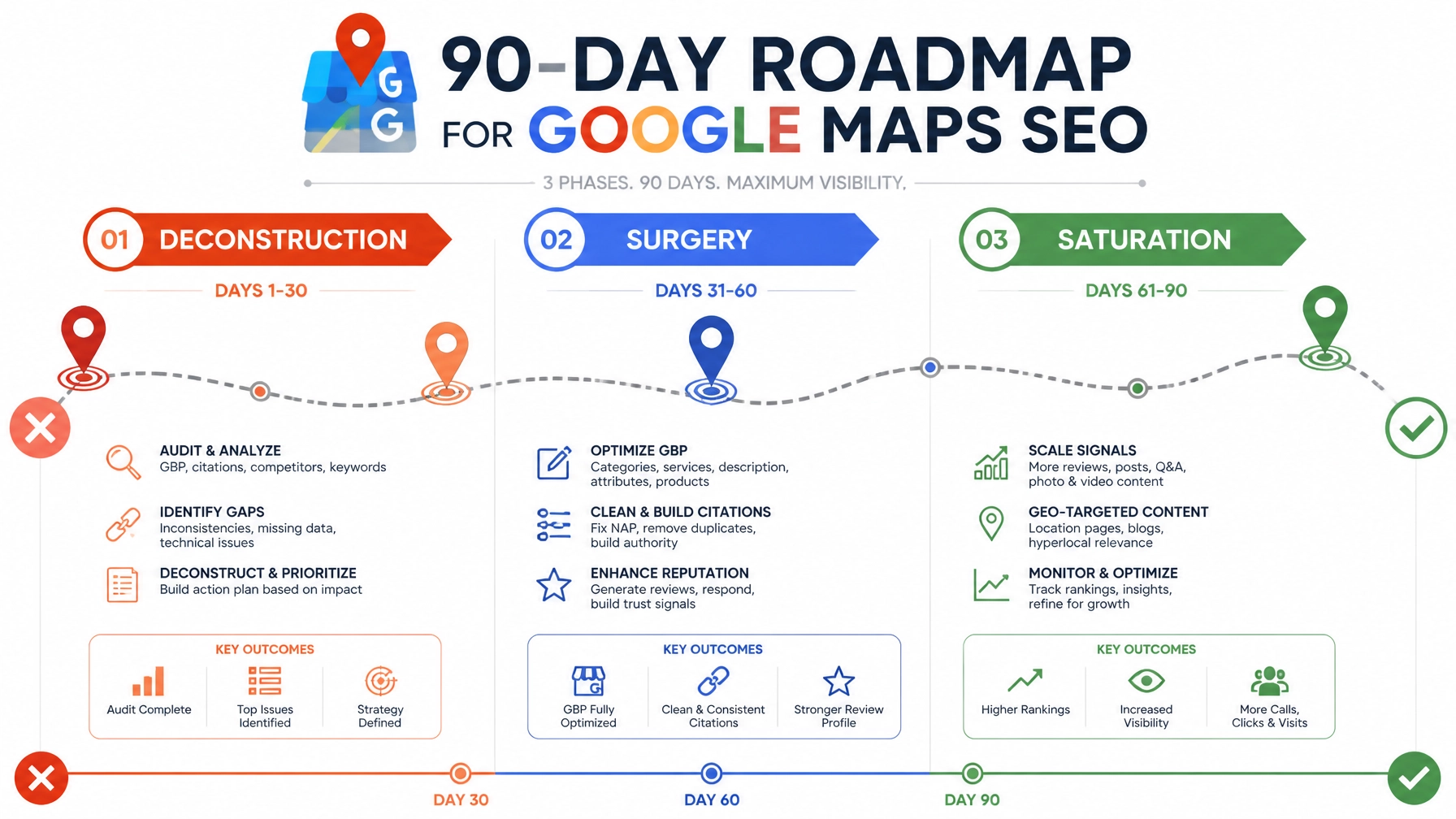
    At RankLift Lab, we don't deal in "visibility" or "brand awareness." We deal in phone calls. This is our 90-day forensic framework to stop the bleeding and achieve market saturation.


    Days 1–30: Forensic Deconstruction & Category Pruning

    The first 30 days are about Forensic Audit and clearing the noise. Most Google Business Profiles (GBP) are cluttered with "Category Dilution": the technical equivalent of trying to speak five languages at once and being understood by no one.

    The GBP Survival Audit

    We start with a clinical examination of your profile. If your metadata is inconsistent, you are throttled.

    • Primary Category Isolation: If you are a Personal Injury Lawyer, but you’ve listed "Legal Services," "Trial Attorney," and "Mediator" with equal weight, you have diluted your relevance. We prune everything that isn't a high-intent "money" keyword.
    • NAP Congruence: If your address on Yelp says "Suite 200" but your GBP says "Ste 200," the algorithm loses confidence. In the world of Maps SEO, a lack of confidence equals a lack of rankings.
    • The 2-Mile Perimeter Check: We use Geo-grid tracking to see the reality of your situation.

    Geo-grid Ranking Visualization
    Precision mapping reveals exactly where your visibility dies. This is the baseline for your recovery.

    The Goal of Month 1: Establish Entity Congruence. We ensure Google knows exactly what you do and exactly where you do it.


    Days 31–60: Technical Surgery & Signal Injection

    Once the foundation is stable, we move to Technical Surgery. This is where we align your website’s skeletal structure with your GBP.

    Metadata Sterilization

    Your website is the "brain" for your Google Maps listing. If the brain is slow or confused, the body doesn't move.

    • On-Page Dominance: We optimize your location pages to capture high-intent searches. We don't just put "Plumber in Austin." We build out hyper-local content that references specific intersections and landmarks to feed the proximity algorithm.
    • Speed Optimization: If your site fails LCP (Largest Contentful Paint) targets, you are penalized. Slower sites are relegated to the "Local Footnote" section of page two.
    • Review Cadence Structuring: Random reviews are weak signals. We implement a structured cadence. Constant, high-velocity reviews act as a heartbeat signal to Google that your business is the dominant authority in the area.

    Ranking Improvement Metrics
    When technical surgery is successful, the data reflects a sharp, upward trajectory in impressions and clicks.

    The Goal of Month 2: Force the algorithm to recognize your prominence. We move your pins from red to orange across the grid.


    Days 61–90: Market Saturation & Geo-Grid Expansion

    By day 60, you should be seeing "results you can hear": the phone starts ringing from neighborhoods you previously couldn't reach. Month 3 is about breaking the 2-mile trap and achieving total saturation.

    Breaking the Proximity Ceiling

    Most agencies stop when you hit #1 at your office address. We keep pushing.

    1. Geo-Grid Saturation: We monitor your ranking at every major intersection. If you are #1 at the office but #7 three miles north, we inject local signals (location-specific posts, geo-tagged images, and local citations) to bridge that gap.
    2. Competitor Throttling: We identify competitors who are "squatting" on your territory with fake addresses or keyword-stuffed names and we initiate the forensic cleanup process to remove them from the Map Pack.
    3. Conversion Optimization: Traffic is vanity; bookings are sanity. We refine your GBP posts and Q&A sections to answer the "Why you?" question before the user even clicks your website.

    Comparison Map
    Transformation from local footnote to market dominant. Green pins mean you own the traffic.

    The Goal of Month 3: Total market dominance. Your business becomes the default choice for the algorithm and the customer.


    The Hard Truth: Dominate or Disappear

    The local search market is binary. You are either in the Top 3 "Map Pack," or you do not exist.

    If you are not using Geo-grid tracking, you are flying blind. If you are not performing Category Pruning, you are confusing the very engine that is supposed to send you leads.

    Every day you wait is another day your competitors are solidifying their lead. Your revenue is being throttled by an algorithm you don't control, using a framework you don't have.

    Stop losing calls.

    It’s time for a Forensic Audit of your current visibility. Let us show you exactly where you are bleeding money and how we can fix it in 90 days.

    Book Your Visibility Audit Now


    What to Expect After 90 Days:

    • Radius Expansion: Your ranking zone expands from a 2-mile radius to a 10+ mile dominance zone.
    • Lead Velocity: An increase in high-intent phone calls and direct bookings.
    • Zero Long-Term Contracts: We stay accountable by delivering consistent momentum. If we don't deliver results you can hear, we don't expect you to stay.

    Are you ready to stop being a local footnote? Start your plan today.